I’m not ready for my close up…

Vulture Acrylic Painting by Julie RustadA vulture has a face that only a mother could love. So instead of painting a close-up of it’s naked wrinkled head, I chose to capture the foreboding 6 foot wing-span that is synonymous with this Southwest scavenger.

Here’s the step-by-step visual of how I painted a Turkey Vulture.

Step 1: A wash of Cerulean blue for the background.

Vulture Acrylic Painting by Julie Rustad - Step1

Step 2: Using a few shades and tints of a mix of Burnt Sienna and Light Portrait Pink I painted the shapes that create the vulture’s facade.

Vulture Acrylic Painting by Julie Rustad - Step 2

Step 3: Using a darker mixture of Raw Umber and Thalo Blue I added more shadows and definition to his feathers. I also added his bright red head and pointy beak.

Vulture Acrylic Painting by Julie Rustad - Step 3

Step 4: Using almost a pure white hue, I added the highlights to the bottom of the feathers to illustrate how the sun’s light peaks through the very tips of them. I also used a much smaller brush to create the details in his face like his eye and wrinkles.

Vulture Acrylic Painting by Julie Rustad - Step 7

Step 5: At this point I thought I was done…but I was not 100% satisfied with Mr. Vulture. He seemed dark and not as fun as some of the other “Desert Dwellers” I’ve painted, like the Roadrunner or Kangaroo Rat.

So instead of posting him on Facebook…I waited a day…or two…and looked at him again with fresh eyes.

Vulture Acrylic Painting by Julie Rustad - Step 8

Step 9: I decided to brighten up his feathers and get rid of the sharp contrast I had created at the bottom of them. By blending three separate color mixtures that included a Titanium white, Cadmium Yellow, Vivid Red Orange, and a bit of Cadmiun Red Medium, I achieved a more continuous and lighter feel to his feathers.

I also used the opportunity to lighten up the background. By using more white, I tried to create a more interesting contrast between the top of his body and the sky. I wanted the top of his feather to pop more from the lighter background.

After these “final” enhancements, I felt ecstatic! Here’s he is…

Vulture Acrylic Painting by Julie Rustad

This feathery family member of the “Desert Dwellers” is available for purchase!
Like all of my prints, he’s only $25 in a matte and loves to fly to new places.

U is for Unicorn?

U is for Unicorn

U is for Unicorn. Really?! What part of the planet do Unicorns live on? Definitely not in the southwest. I am surprised to find so many alphabet books for children use fairly common animals and then use a Unicorn for the letter “U”!

Finding an animal that starts with a “U” is pretty tough, especially for a particular region. I’ve seen “Urchins” in some of the books as well, but I’ve never seen an urchin in our lovely desert! And that is why the best possible animal for my southwest alphabetical series of “Desert Dwellers” is…..

Uinta Chipmunk Step 7 Acrylic Painting by Julie Rustad

The Uinta Chipmunk!

While researching these chipmunks, I’ve learned that there are approximately 13 species of chipmunks in the US! Who knew? They are all very cute and some look very similar to one another. The Uinta’s live in the southwest, but I think we are more likely to find them up at The Grand Canyon than right outside my door in Tucson, AZ. Too bad, cause I love their stripes!

I really enjoyed painting the Uinta Chipmunk. I’ve deduced that painting FUR=FUN! See below for a visual step by step of my painting process:

STEP 1: I layered some dark and yellow green onto the canvas.

Uinta Chipmunk Step 1 Acrylic Painting by Julie Rustad

STEP 2: I outlined the chipmunk’s body shape in a sketch-like manner.

Uinta Chipmunk Step 2 Acrylic Painting by Julie Rustad

STEP 3: Using a few tints and shades of a tan/brown hue, I added areas of color.

Uinta Chipmunk Step 3 Acrylic Painting by Julie Rustad

STEP 4: Using a smaller paintbrush, I made more specific strokes in the direction of the fur.

Uinta Chipmunk Step 4 Acrylic Painting by Julie Rustad

STEP 5: I added more shadows with a darker hue.

Uinta Chipmunk Step 5 Acrylic Painting by Julie Rustad

STEP 6: I added definition to his ears, eyes, hands, and feet.

Uinta Chipmunk Step 6 Acrylic Painting by Julie Rustad

STEP 7: After I blended the background, added more wispy hairs and did one last review — he was finished!

Uinta Chipmunk Step 7 Acrylic Painting by Julie Rustad

What do you think? Uinta Chipmunk vs Unicorn
Here’s hoping that my friends in the Southwest will appreciate the shout out to one of our local creatures, instead of the magical and mythological unicorn.

Do you want your own “Uinta Chipmunk”?
Matted prints of this chipmunk are available for $25. Purchase from my Julie Originals website or email me at julie@julieoriginals.com.

The next southwest animal is…
Now that the Uinta Chipmunk is complete, I have begun painting a Vulture!  Subscribe to my blog to be the first to see how it turns out! :)

Monthly Print Giveaway!
Everyone that leaves a comment on my blog will be entered into a drawing to win a free 8×10 matted print of their choice. I will announce the winner in the March 15th Julie Originals E-News. Click here to subscribe to my e-newsletter to find out if you won!

Blogging Changed My Life

6 Southwest Animals "Desert Dwellers" Paintings by Julie Rustad
Roadrunner, Scorpion, Diamondback, Kangaroo Rat, Ornate Box Turtle, and Northern Mockingbird by Julie Rustad

“Design Without Computers”… Not only was it my first blog post, but it was the start to making a huge change in my life! Although I have always loved to draw and paint, I wasn’t making it a priority. Instead I was designing and creating using my computer. I let my commercial work dictate what kind of art I was creating. Don’t get me wrong – that’s how I made money, but I was really craving something more.

In September 2011, I decided to get more “hands on” with my art. I thought that if I had a blog – it would make me accountable. At first I began posting about a few DIY projects, an illustrated book for my son, but then I fell effortlessly into painting again. OH – HOW I MISSED PAINTING!

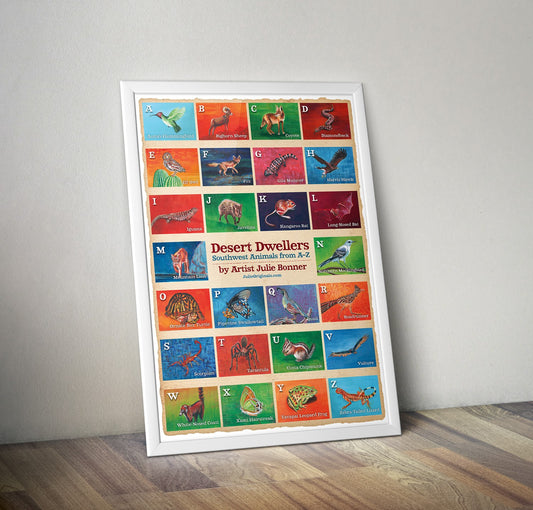
I created the goal, “To paint 26 animals in 31 days!” A LITTLE INSANE, but it helped direct my creative energy. I created a list of southwest animals in alphabetical order and started with Anna’s Hummingbird. Having a plan like this made it easy to get started immediately when I had the chance. Whether my son was taking a nap or my husband was watching him – all I had to do was refer to my list to see which animal I would be painting next.

It also helped that I made my painting supplies easily accessible. I used to think that it was a lot of work to get set up, but now I have a box for my acrylic paints, my canvas, and paintbrushes right on the shelf above my desk.

While I paint I listen to podcasts. My favorite one is “Artists Helping Artists” because it provides so much valuable information to Fine Artists, especially newbies like me. The hosts, Leslie and Dreama, are enjoyable to listen to and I find myself using their tips and advice quite often. I feel super productive because I am learning, but also expressing myself by painting at the same time.

Throughout my painting process, I snap photos with my phone. I thought this would be a way to provide a step by step visual. Then I import these into WordPress.

Once a painting is complete, I write the blog post. I try to keep it simple, with lots of the pics that I took.  Then I post it — and then…..look forward to getting feedback! Here’s an example of my step by step posts.

In the past, I had written in my journal, “I need to paint more”….but just writing that, didn’t make it a reality. Although I had the best intentions of painting more often – it wasn’t until I started this blog that it came true! I really like the community feeling from blogging. I share my art and document my process and in return learn about other blogger’s talents, triumphs, and stories. It’s like having a virtual support group.

At this moment, I’ve completed 21 southwest animal paintings with only 5 more to go! I plan to continue to paint for the rest of my life. I am so happy!

To top off all of this love for painting — I have some really fun shows coming up. I am participating in a neighborhood art show in March with two other artists. Here’s the flyer I designed.

3 Artist Show in Tucson featuring Julie Rustad, Jack Busy and Kay Parks

Then in April, I will be the guest artist at the Madaras Gallery in Tucson. This is such an honor, I am so excited!!!! (I will be posting more details on this – so stay tuned.)

I couldn’t have imagined participating in these exciting events 6 months ago. My life has really changed…and I feel like blogging was the catalyst!

Has blogging changed your life too? Please share your story!

Not so itsy bitsy…

I showed my 16 month old son this painting and he started doing the “Itsy Bitsy Spider”. That cracked me up! He’s at the age where he recognizes a lot of animals and either makes gestures or mimics their noises. I am having a blast painting southwest animals and loves that he finds them so entertaining. If you haven’t guessed what I painted yet, it’s a fuzzy wuzzy Tarantula.

Tarantula Acrylic Painting by Julie Rustad - Step 8

Similar to the scorpion’s ancient history, “Tarantulas are primitive spiders that evolved almost 350 million years ago and have changed little since. They are also venomous like all spiders, but they are very docile and bite only under extreme provocation.” Here’s more of the article about tarantulas in Tucson.

I’ve seen a tarantula twice out of the 8 years I’ve lived in Tucson. Once in Sabino Canyon during a hike. The second sighting was when it crossed our bike path after a monsoon. They are fascinating to watch..from a distance ;)

This is the 20th southwest animal I’ve painted since October — only 6 more to go!

Here’s how I painted the “itsy bitsy spider” from start to finish using acrylics.

STEP 1: I started with a pink hue and covered the entire canvas.

Tarantula Acrylic Painting by Julie Rustad - Step1

Step 1

STEP 2: I sketched out his body and legs, using a lighter color. 

Tarantula Acrylic Painting by Julie Rustad - Step 2

Step 2

STEP 3: Using a mix of brown and red, I filled in the tarantula’s overall shape.

Tarantula Acrylic Painting by Julie Rustad - Step 3

Step 3

STEP 4: I added more texture and other colors to provide more visual interest in the background.

Tarantula Acrylic Painting by Julie Rustad - Step 4

Step 4

STEP 5: I created an even darker brown color to add shadows on his body.

Tarantula Acrylic Painting by Julie Rustad - Step 5

Step 5

STEP 6: Let’s get FUZZY! I used a smaller brush and a golden yellow to add hair.

Tarantula Acrylic Painting by Julie Rustad - Step 6

Step 6

STEP 7: Here’s what he looks like after lots more hair was added. I used a variety of colors to create this look.

Tarantula Acrylic Painting by Julie Rustad - Step 7

Step 7

STEP 8: I thought I would be done around at Step 7, but it just didn’t feel right. Sometimes it helps to take a break and come back to it. With fresh eyes I realized he looked like he was floating. To solve this levitating issue — I added a blurry shadow underneath him. Then I felt like he was grounded and the painting was DONE!

Tarantula Acrylic Painting by Julie Rustad - Step 8

Step 8

My favorite part of this process was painting the hair on the tarantula. It was a lot of fun working on his fuzz-factor!

Do you want your own “itsy bitsy spider”?
Matted prints of this Tarantula are available for $25. Purchase from my Julie Originals website or email me at julie@julieoriginals.com.

The next southwest animal is…
Now that the Tarantula is complete, I have begun painting a Uinta chipmunk! They are SOOOOO CUTE! Subscribe to my blog to be the first to see how it turns out! :)

Facing My Fear of Scorpions

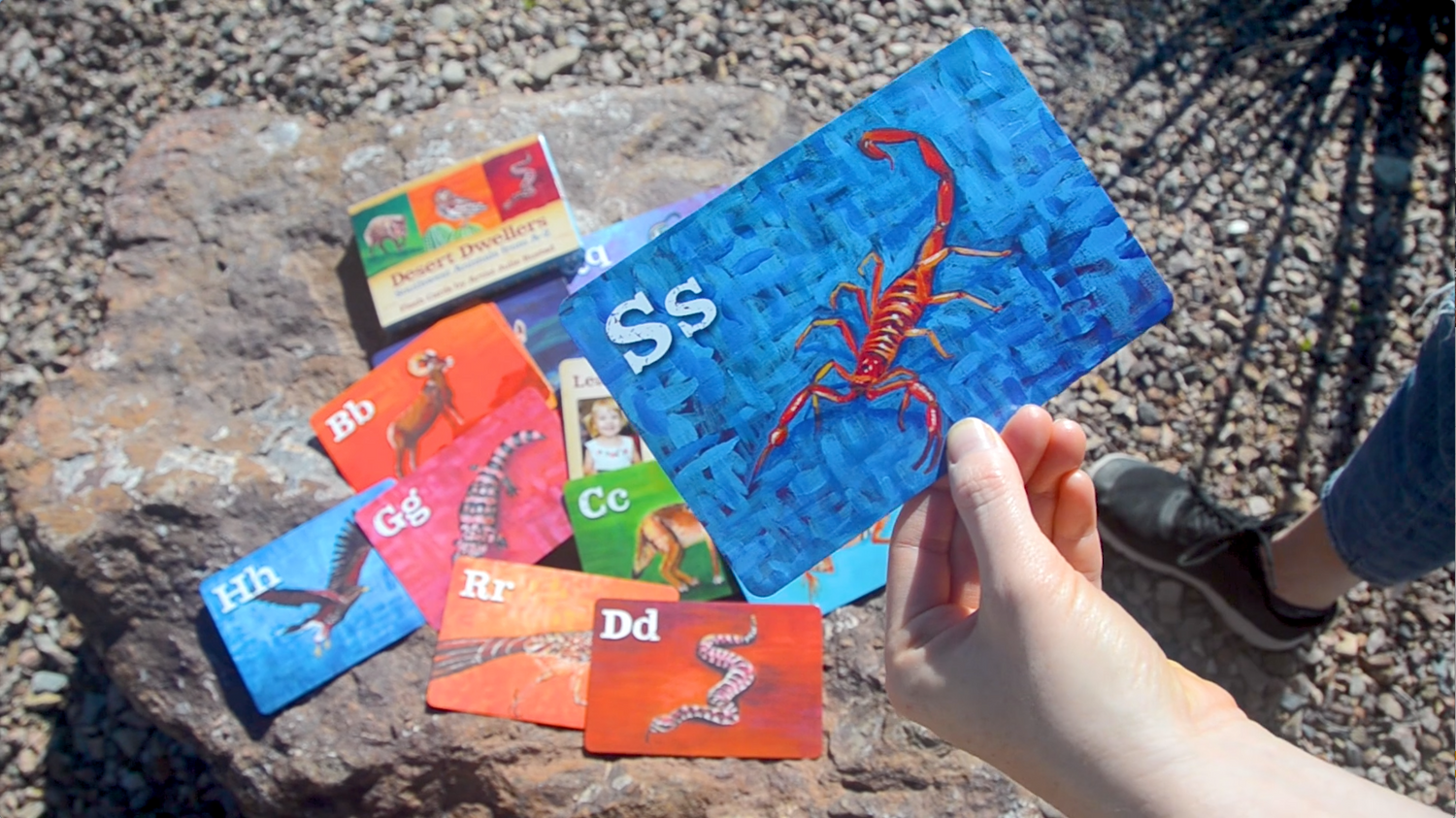
I have to be honest, I think scorpions are creepy. I’d rather paint another bird, but how could I leave out this notorious little guy from my series of Southwest Animals paintings? Not only are scorpions said to be 400 million years old, but there are 30 different species living in Arizona. With my kitty helper, Levi, I worked hard to get over the creep factor and paint a scorpion to be proud of.

My cat Levi helping me paint

Levi sits on top of my chair as I paint - He's only stepped in my paint once..;)

Here’s how I painted a scorpion, start to finish!

Step 1: I painted the background a purple hue to be consistent with the 18 southwest animals I’ve already created. You can see all of the paintings here.

Then I loosely sketched the body shape of the scorpion with a lighter color.

Scorpion Painting by Julie Originals - Step 1

Step 1 of Painting a Scorpion

Step 2: I filled in the shape of the scorpion and added more detail to it’s tail and lobster-like arms.

Scorpion Painting by Julie Originals - Step 2

Step 2 of Painting a Scorpion

Step 3: Using bright orange and yellow/orange acrylic paint, I filled the body with these new fun colors.

Scorpion Painting by Julie Originals - Step 3

Step 3 of Painting a Scorpion

Step 4: Using an almost white/yellow, I added highlights to the shell to make the scorpion appear more dimensional.

Scorpion Painting by Julie Originals - Step 4

Step 4 of Painting a Scorpion

 Step 5: During this step, I created the Julie Originals signature texture in the background. You can see this in the Roadrunner painting also.

I mixed the paint to create a dark red brown hue and added this shade to the scorpions back and tail.

Scorpion Painting by Julie Originals - Step 5

Step 5 of Painting a Scorpion

Step 6: I continued to work on layering the background, while at the same time defining the edges of the scorpion.

Scorpion Painting by Julie Originals - Step 6

Step 6 of Painting a Scorpion

Step 7: I wasn’t happy with the dark purple behind the scorpion, so I decided to change the whole background. I thought blue would be complementary to the orange scorpion, but help lighten up the vibe of the painting.

I added some white highlights to the scorpion’s shell. At this point, I felt like it was time to stop.

Scorpion Painting by Julie Originals - Step 7

Final Step of Painting a Scorpion

Since painting this scorpion, I think I am a little less creeped out and might consider hanging this one up at home…but maybe not in the bathroom!

Would you hang this scorpion in your house?

If you’d like to bring one home – prints of the scorpion are available for purchase on my website here.

Matted prints for $25 and framed prints for $50. (s/h not included)


I captured a roadrunner!

Roadrunner Painting by Julie Originals

The roadrunner is one of my favorite southwest animals in Tucson. I consider them good luck when they cross my path. In this painting, I captured one running. Here’s a behind the scenes look at my design decisions during the painting process:

STEP 1: I used a bright orange hue for the background which works well with the previous 17 paintings in this series.  Using a lighter color, I sketched the roadrunner’s body. Because I am using acrylics, I am not worried about it being perfect. I feel confident that I can paint over any part I do not like. You will see in the photos below, how I layer paint to edit the image as I go.

Roadrunner Painting by Julie Originals - Step1

STEP 2: Then I quickly layer a light cream and darker brown shade to start defining the top feathers, lower body and beak of the roadrunner. I like to make sure I fill the shapes in, and then layer paint on top as I progress.

Roadrunner Painting by Julie Originals - Step 2

STEP 3: Then I mixed a red/brown and a gray to start defining the feathers and legs of the roadrunner. At this point I am still using a medium sized brush and working pretty quickly.

Roadrunner Painting by Julie Originals - Step 3

STEP 4: Time to focus! I use one of my smallest brushes to detail the light and dark feathers of the roadrunner. This step took longer than the previous steps. Not only am I adding more detail, but I am trying to use complementary hues to create greater dimension for the roadrunners legs and beak.

Roadrunner Painting by Julie Originals - Step 4

STEP 5: At this point, I used a broader brush to make a more interesting background. For some reason, I having been adding this kind of cross hatch pattern on most of the paintings for this southwest animal series.

Roadrunner Painting by Julie Originals - Step 5

STEP 6: As I finish up this painting, I use the absolute smallest brush to paint the eyes and other tiny details. I also work on really giving the feathers, more of a feathery look with my strokes. The feet and the roadrunner’s sharp curled up toenails also needed more definition.

Roadrunner Painting by Julie Originals - Step 6

Done! Looking back at this painting, I think I should have drawn him a bit smaller so I could have fit in more of his tail within the canvas. As a graphic designer, I tend to crop images to highlight the interesting details. Would you have liked to seen more of his tail?

These photos were taken with my Iphone while I was painting. I’ve created a slideshow below that shows them animates them from start to finish.
Is this helpful to see? Would you ever like to see a sped up video of one of my paintings?

Now that I’ve captured a roadrunner to hang on my wall, I will always have good luck! If you want some roadrunner’s luck too, you can purchase a print on my Julie Originals website.

“Does this color make my head plume look fat?”

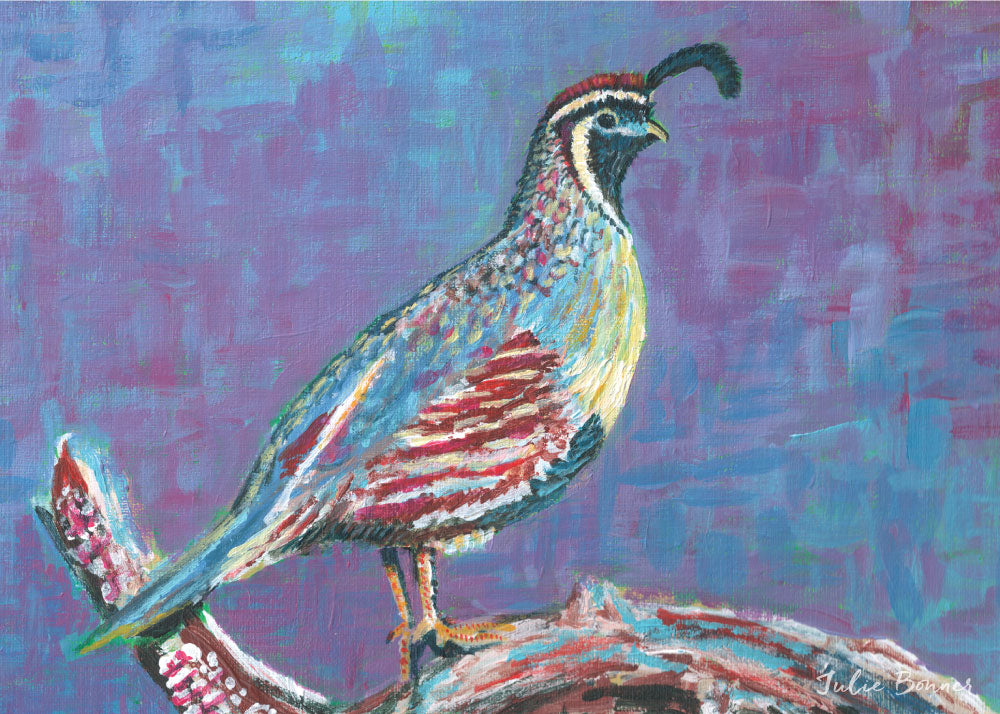
Gambel's Quail - Painting by Julie OriginalsAlthough I wasn’t able to paint 26 Animal Paintings in 31 Days, I am happy to report that I’ve painted 17 southwest animals in the past three months! This week I painted a Quail – here’s how:

Gambel's Quail Step 1 - Painting by Julie Originals

STEP 1. Like my previous animal paintings, I use a wash of color across the canvas to begin. This green hue is one of the bright colors in the palette I have been using for this animal series. Then I sketch out the shape of the Gambel’s Quail and the stick it is resting on.

Gambel's Quail Step 2- Painting by Julie Originals

STEP 2: Time for COLOR! I add in blocks of paint with a medium size brush, based on the photo and what I feel. Here you can see some light blue, a brown red, and some warm yellow paint.

Gambel's Quail Step 3- Painting by Julie Originals

STEP 3: I use a smaller brush and add more detail to the background, quail and branch. Although I liked the direction the bird and branch had gone, I did not like the green background. There was a disconnect between the two and felt it was distracting. I decided to change it to something that worked better with the coloring of the Quail…

Gambel's Quail Step 4- Painting by Julie Originals

STEP 4: I pulled some of the various colors that were in the Quail to create the new and improved background. No longer bright green, the canvas is a mix of a purple, magenta and light and medium blue hues. What do you think?

Bring this quail and his cute head plume home by purchasing a print.

Frame of Personality

Personalized Painted Frame Before and After

I wanted to make a cute frame for a cute kid. It was for her first birthday and I knew I wanted to make a special gift.

I had a blast making over a plain wood frame! Maybe it’s because I don’t really make super girly flowery things for Syver? Go figure…

Here’s how I did it – step by step!

1) The frame was one of those wooden one’s that you can get at Michael’s. (It was on sale for a $1!)

Before - Wood $1 Frame from Michaels

2) Before starting to awesomefy this frame, I wanted to come up with a style that would match the birthday girl’s fun personality and room! She is a happy and easy going baby. Her room decor is pink and chocolate brown. Her Mom dresses her in cute outfits, including floral – so I decided that flowers would be one of the design elements.

3) I painted the entire frame a bright pink. Then added some flowers and swirls using acrylic paint and a small brush.

Flowers on Custom Frame by Julie Originals

4) I used stickers to spell out her name. These stickers were on a sheet for scrap-booking. They actually stuck on really well.

5) Then I used the Martha Stewart Glitter Glue 24-Pack to add sparkle. I accented the letters in the name and used it to add a stroke around the flowers. I loved how easy the glitter glue was to use.

Glitter and Paint on Custom Frame by Julie Originals

(I wish my photos looked better of these stages – I was working at night and used my desk lamp to light them – it did not do the glitter and colors justice!)

6) At this point I could have been done — but I didn’t want to give a frame without a photo. So I found a snapshot of the birthday girl and my son playing. The original photo looked too busy within the frame, so I did some photo editing in Photoshop.

As you can see in the revised version:

  • Instead of using the 4-color version, I created a duotone using a warm yellow and a dark blue
  • Then I highlighted the ladybug by painting it pink and changing the blending mode of the layer
  • Finally I cropped it so that the emphasis was on the kiddos

Photo Editing for Personalized Photo Frame

7) Here’s the finished the gift! I am really satisfied with how the edited photo worked within the custom frame.

Personalized Art Frame by Julie Originals

8) Although most people don’t see the back. I added a note behind the photo with a birthday wish and my new Julie Originals stamp.

Julie Originals Back of Custom Frame

I am happy to say that I saw the frame in her room today! That is one of the best feelings.

Have you created a custom frame? I’d love to hear about your DIY frame transformations.

Put An Owl On It

Elf Owl in Tucson Arizona Painting by Julie Originals

Owls are the new “birds”. What I mean is that currently on ETSY, there are 86,821 items that are selling with owls on them. For awhile, anything that was hip or whimsical had a bird on it (Portlandia’s Put A Bird On it)

Owls on Etsy

Now everywhere I look I see owls! I am not an owl hater – in fact, Tucson is home to one of THE CUTEST and SMALLEST OWL’S EVER… The Elf Owl!

Elf Owl Photo by Roger Hirschman

© Roger Hirschman / ASDM Sonoran Desert Digital Library

The Elf Owl was the subject of my fifth painting for my alphabet animal series. I chose to paint one sitting on a cactus. I wish that I could have somehow captured the scale of it better – they are only about 5″ tall. Did I mention – they’re sooooo cute!

I had much more fun painting this guy versus the snake I previously painted. I might even sell some art prints of the painting. Then I could own the 86,822 owl item on ETSY!

Have you purchased anything with an owl on it?

A Snakeover – From Sloppy to Sophisticated

DiamondBack Acrylic Painting by Julie Originals

Who LIKES snakes? Not me! I was NOT excited about painting a Diamondback Rattlesnake. I prefer to illustrate cute kitties and birds, but I was committed to my 26 Alphabetic Animals in 31 Days Project.

The next letter was “D” and that stood for the Diamondback, one of Tucson’s venomous inhabitants.

Here’s my process of how this snake went from sloppy to sophisticated. I began with the background and then sketched out the rattler’s squirmy slithery body.

Diamondback Rattlesnake Acrylic Painting Step 1

I added some light and dark values to add depth and create texture for the snake’s scales.

Diamondback Rattlesnake Acrylic Painting Step 2

I felt that my painting was turning out to be the sloppiest most blah painting I had ever done. I wanted to quit partway through and just trash it. Luckily I was listening to an interesting podcast called “Artists Helping Artists” and I kept on painting.

Diamondback Rattlesnake Acrylic Painting Step 3It helped that I was listening and just painting, instead of over thinking each decision. Zoning out really helped to get over the “ugly hump”. Do you ever get discouraged part way through a painting?

Diamondback Rattlesnake Acrylic Painting Step 4

One of the challenges I had was trying to paint really detailed scales. All of these paintings are only about 7″ x 5.5″ and although I use a pretty small brush, I found it was hard to get that sort of dotted scaled look. Does anyone have any tips for painting details like that?

Julie Originals Acrylic Paintings

Once the “Snakeover” was complete, I stood back and felt pretty satisfied with how it turned out. I am glad I didn’t stop or trash the painting.

Now I have 4 out of the 26 paintings completed:

  1. Anna’s Hummingbird
  2. Bighorn Sheep
  3. Coyote
  4. Diamondback

What animal do you think “E” will be?

Colorful Coyote Painting – Visual Step by Step

Tucson Coyote Acrylic Painting by Julie Orginals

This isn’t your typical teal and peach howling at the moon coyote! Here’s how I painted a more colorful and fun version of a Tucson coyote.

A visual step by step

STEP 1) Just like my previous Bighorn Sheep painting, I painted a vibrant color for the background. Because I am doing an animal alphabetic series, I tried to choose a different color than the background I used for the Hummingbird painting. I knew I was going to use a lot of orange and tans for the coyote, so I went with a complementary yellowish/green mix for the back.

Coyote Painting Step 1 Julie Orginals

STEP 2) After doing a “sketch” of the coyote’s body using one or two colors, I started filling more of it’s body in. I fill it in quickly before going into any details.

Tucson Coyote Painting Step 2 Julie Originals

STEP 3) At this point I add more dark and light values to so the coyotes look more dimensional. I also used brush strokes to mimic how the coyote’s fur lays.

Tucson Coyote Painting Step 3 by Julie Originals

STEP 4) I continued to add more detail using the smallest brush I own. I also added a desert background with some native plants. I chose to make them more of a secondary element. I wanted to make sure that the main focal point was still the coyote.

Tucson Coyote Painting Step 4 by Julie Originals

This 26 animal project is really inspiring me to paint during any available time that I have (which is tough, with a one year old!) For those two hours, I get to zone out and really enjoy the process.

What do you think the animal starting with “D” will be?

What’s your painting project?

My advice for those that want to start painting more, would be to come up with your own mini-project. For example, maybe you would like to give a few paintings for Christmas this year.  This would be the perfect time to start.

Come up with a list of who you’ll be creating them for. You can even customize each painting based on what your family is into. Say you’re dad likes golf –maybe you can take a photo of his favorite course and then paint it.

I would love to hear if any of you choose to create your own painting project. Please share with me how it’s going!

[contact-form] [contact-field label="Name" type="name" required="true" /] [contact-field label="Email" type="email" required="true" /] [contact-field label="Comment" type="textarea" required="true" /] [/contact-form]

Bighorn Sheep Like to Rock

I just completed my second painting out of the 26 I am planning on painting this month! Here’s photos of how I painted this in two hours.bighorn sheepB is for BIGHORN SHEEP
This time I chose to paint a Bighorn sheep. This is my letter “B” animal for my alphabet animal project. Although I haven’t seen any of them while hiking, I have been able to watch them at the Arizona-Sonora Desert Museum. It’s pretty amazing how they scale their mountainous  terrain.

THE STEPS
1) Usually I first try to cover the canvas with color immediately. Then I created a sketch of the sheep’s body.

2) I start adding in more light and dark values to start defining it’s shape more.

3) Then I went to an even smaller brush to start adding more detail. I also worked with other colors besides brown to start making the painting more interesting. Instead of using a black paint, I mixed one of my dark blues with a reddish brown to give a nice dark hue to use for the shadows on the sheep. I also used different values of red for the rocks, instead of just a grayish color.

4) At the very end I fine tuned the painting by adding the very small details to the sheep and also adding some cracks and texture to the rocks it is standing on.

Just like the Anna’s Hummingbird painting, I completed this in two hours. Although I  am getting a real process down for this project, I better move quickly to finish the remaining 24 alphabetic animals!

What animal do you think “C” will be?

26 Animal Paintings in 31 Days

Today I began a large alphabet project that I have been planning for awhile now. While my son was in class this morning, I pulled out my canvas paper, acrylics and got down to it. I began painting one of Tucson’s beloved little creatures, Anna’s Hummingbird.

I see these cuties everywhere, so I used some of the photos I had taken as reference. I put on a podcast and after two hours, I was done!

This will be one of 26 animals that I will be painting over the next month. Sound a little crazy?  Since I had previously created a children’s board book in two weeks, I am ready for this challenge too. Having a deadline forces me to take action. Do you find the same thing?

I will be posting each animal as I complete them, so please subscribe to find out what the next one will be.

What animal do you think “B” will be?

Board Book Design and Illustration – In Two Weeks!?

I wrote, illustrated and designed a custom board book during two weeks worth of my son’s naps and bedtimes!

My son, Syver, loves when we read board books together. His favorite is Dr. Seuss’, “Hop On Pop”. This triggered my idea to design a personal board book for his birthday! The biggest obstacle was….

His birthday was in two weeks! I was up for the challenge!

I’ve found a place in NY (not China) that would manufacture a board book using my art work. The first step was learning what their specs were.

Board Book Specs:

  • 5 5/8 x 5 5/8″round corner trimmed board book.
  • 7 interior spreads plus the cover spread
  • made of thick 48 pt solid white durable paperboard

I was so excited! These are the type of specs that so many legit board books have. I couldn’t wait to create a real baby-proof book!

Coming up with a concept:
Once I knew the format specs, I brainstormed an overall concept for the book. I thought maybe something having to do with music because my husband and I play in a rock band together called the HypnoGogs. Our son seems to also enjoy playing the keyboard, guitar and drums. He’s our little rock star and that is what I focused my ideas about. Here’s my ideas scribbled in a journal. Ideas for the Custom Board Book

The right page shows how ROCK STAR is the main theme and the sub categories I’ve written all around it. Some of them are Fans, Concerts, Paparazzi etc… Then on the left page I’ve tried to be more specific with my ideas. I think I came up with eleven spread ideas. Because this board book will only include seven spreads I had to narrow down the one’s that I thought were the best seven.

Board Book ThumbnailsThumbnails:
I always draw a birds eye view for any project. It helps me “picture” how everything works together. Here’s thumbnails of how I layed out the board book. The top left is the cover/back cover and the rest are the spreads. Although I might look like scribble it helps me stay organized.

Then I started working in my sketch book. Using a ruler, I measured out the correct frame for each book spread.

Let the drawing begin!
I worked quickly on each of the spreads using a pencil. I wanted to see how the illustration looked on the page before getting too detailed. I also left some negative space for the text. Here’s the spread that show’s Syver pushing his favorite little train down the red carpet, while being stalked by the paparazzi.

Sketch of One of the Spreads

Writing?!
At this point, I felt like something was missing. I had originally wanted to just put something like “Paparazzi”, “Touring” and “Jam Session” – but I decided that it wouldn’t be very much FUN to read. Plus Syver would have no clue what I am talking about! So I decided to take a cue from Dr Seuss and make this book lighthearted and FUN!

After sitting down and writing for 20 minutes, I came up with all seven rhymes. The “Paparazzi” spread changed to, “From crawling to walking you’ve really grown, and get lots of ATTENTION wherever we go!” I was happy with the improved versions and it was time to move on…

Ink
After feeling satisfied with my sketches, I used Micron pens to create the permanent artwork I would be coloring in. Then I erased all of the pencil lines.

Illustration of Board Spread

Bring on the COLOR!
I used my Prismacolor pencils to to add texture and color to the book. I worked on this at night after I put my son to sleep. I really enjoyed this part. There is something so relaxing about drawing and coloring – that’s why I started this blog! I missed getting hands-on.

Here’s what the spreads looked like before scanning them into the computer. I layed them all out on the floor to double check if they all had a similar color palette and feel.

Yes – I used the computer (but just a little)
After importing the artwork into the Adobe illustrator templates the printer had sent, I wrote out the text onto each spread. Originally I wanted to draw the text, but I decided that was a little too risky, due to my short deadline. I purchased a digital font that had a hand written quality about it. At first I kept the words on two separate lines, but then I realized I wanted to make the text more dynamic as well. Here’s how I broke up the text on the spread:

Once I was satisfied with how the text looked, I double checked my files and created one final high-res PDF. I was just about done! I uploaded my artwork to the printer, paid and then was so excited I couldn’t fall asleep!Pint Size Productions did a fantastic job printing and sending me the book super fast. I was ecstatic to receive the final book two days before Syver’s birthday!

The best part about this fun and fast project was getting to read the finished book to Syver. He LOVED it!

Creating a board book in two weeks was a lot of work, but totally worth it!

Homemade baby gift – Easy Tutorial

What do you get a one year old for their birthday? My son’s friend, Casey, was turning one and I knew that he already had received lots of gift cards, clothes and toys from his family back East. I thought, “What could I get for him?” Then I changed that to be…what could I make for him….


Casey Framed Name

This post is a step by step of how to make a homemade baby gift. Not only is it a special gift, but the materials barely cost anything. I spent less than $3 on the frame and paper and I finished this project in about two hours.

This project began while I was shopping at an art supply store. I noticed they had a bunch of various matted frames for sale. I found one on clearance for only $1.99!

Picture Frame from Michael's

This frame sparked my idea of creating personalized art for the birthday boy! I imagined getting rid of the three cutouts and illustrating one piece of artwork using his name that could be hung in his room. To me, the hardest and most exciting part of any project is coming up with a concept. I also bought a large sheet of poster paper. At the time I wasn’t sure whether I was going to paint or draw, so I figured the paper could work for either – how could I go wrong at only 59 cents!

Jungle GIft BagI knew I would be using the word Casey in the art, but next I had to finalize what theme or style to create. I knew his room was brown and light blue and that his bedding was jungle themed. Earlier in the week I bought a gift bag on clearance for $2.00. This bag pictured is what I ended up using as a style reference.

Now we get into the fun production part…First I used an x-acto knife to cut the poster paper to the dimensions that would fit into the frame.

Cutting the paperThen using the same proportions, I drew smaller thumbnails of how I might draw his name. The top version used his name as the focal point with some of the jungle characters framing it. In the bottom version, I tried to incorporate the animals into the characters of his name. Like using a palm tree for the “Y”.

Thumbnails of Casey NameFor simplicity, I decided to move forward with the top version. Using pencil, I drew on the cut poster paper. Then used a fine point Sharpie to outline it. After that I erased the pencil lines. Here is how it looked at this stage:

The name has been drawn with a SharpiePrismacolor Pencils

I used Prismacolor pencils to liven up the illustration. I absolutely love using color pencils – although I always have a tough time sharpening these suckers. I usually start filling in layers for the background. I also use a tissue to help blend the different hues.

Casey Half ColoredLast, but not least I finished the illustration by working on his name. The most important part! Here is the artwork in the $1. 99 black frame.

Name in a Black Frame

Mixing Blue Paint to Match the NameAfter seeing the final art in the black frame, I thought it was too dark and had no FUN FACTOR! To brighten the feel, I decided to paint the frame using acrylic paint that I had. I mixed two blues and a little white to match the hue I used in “CASEY”. This was the focal point and I wanted the frame to showcase it.

Then I used the color I mixed and painted the frame. This was super easy and acrylic paints are fast drying. Now I want to paint other frames around my house!

Painting a FrameI also thought a small matted area around the illustration would make it pop. I ended up using the matte that had come with the frame I bought, but trimming it to just a half inch around, instead of the three windows it had before…Matte AfterAfter the frame was completely dry, I inserted the new matte and finished artwork into the blue frame. Here it is completed and hung up. I can’t wait to see it in Casey’s room!

Casey Framed NameI really enjoyed making this gift for Casey! I am finally drawing again. It was project #1 of my plan to make things without the computer.

Was this a helpful step by step project? I would love to get your input! Thanks for reading. – Julie


Design without Computers?!

I was going to call this post – A Graphic Designer’s Rebel Against Computers, but then realized I am using a computer to write this blog, so I suppose the rebellion was pretty weak.

I am going to do my best though, to use this blog to share creative projects that aren’t all created on the computer. I have been a graphic designer for 15 years and I’ve missed drawing, painting, cutting, pasting (literally — not command C & V). Back in college when I was getting my bachelor’s in Graphic Design there seemed to be plenty of time! I used to draw and paint, then manipulate it in Photoshop and lay it out in InDesign (QuarkXpress back then). I loved using my fine art skills in combination with my software skills.

Fast forward to the present and I feel like I’m not able to create my own art like I used to. Deadlines, budgets and style are factors that have worked against me.

Now is the time for me to stop wishing and start doing. I am ready to use my experience with aesthetics, typography, and layout and get my hands DIRTY – sans laptop! I will document my process and share some really fun DIY projects too.

Join me on my creative adventure!